Poem – Swimming Lessons

Our children are bottom-feeders, feeling for a puck in the deep end. Floridian in fuchsia suits, they surface fish-eyed in goggles, gasp, and snort blue water. We sit on the sidelines, barefoot, tapping chlorinated puddles. Pass comments back and forth like cards. In my mind we are pressing the soles of our feet together. I never get my wish. The lesson is always over before I drag you to the deck, cup one hand under your chin, pinch your nose, and breathe myself into your lungs. Our children appear in garish towels, unrelated, though clearly the same species: purple around the gills, hair sleek as sealskin. Whatever happens they will all know how to swim. It is our job to see that nothing does happen. In the parking lot after balmy showers, blowfish bobbing around us in parkas, mouths steaming, you stretch, and mention how you spent the week knocking down a concrete wall. With your head? I wonder out loud. And later, what it takes to get through.

 ——————————————————————————– 3rd Prize, Poem of the Year Contest 2003 Arc 51, Winter 2003


Diving Lessons Learn to Swim Swimming Lessons Teach Baby to Swim


Stretching For Streamlining

Stretching For Excellent Upper Body Streamlining

By Marty Hull. Photos by Rod Searcy.

The fastest we ever go in the water is when we push off the wall. The moment our feet leave the wall, we begin to slow down. If upper body streamlining is excellent, then push-off speed is carried out farther from the wall, and we reach the surface while we are still moving very fast. Excellent streamlining allows a faster lap from start to finish.

What is excellent streamlining? A body that is as straight, narrow and smooth as possible. All three of these can he improved by stretching.

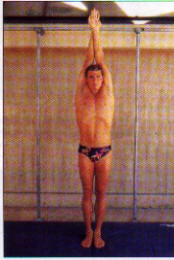
World record holder, Jeff Rouse, has a streamline position that is one of the best in the world. Notice how straight his body is.

(Picture 1).

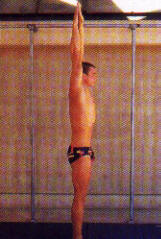
Also, notice how he narrows his shoulders by moving his arms and shoulder blades up alongside and behind his head

(Picture 2).

To take full advantage of what streamlining can offer, you must he able to get to the most ideal streamlined position with extraordinary ease. The more resistance you encounter in your joints and muscles as you try to streamline, the worse streamlining ability you will have, especially late into a race.

Compare your flexibility to Rouse’s. When you extend your arms above your head, are they in perfect alignment with your torso? Does your back arch when you extend your arms over your head? If your arms are not straight in line with your torso or if your back arches even the slightest amount, this will ruin your streamlining.

Can you narrow your shoulders by moving your shoulder blades and arms up alongside and in behind your head? If you can’t, then your streamlining will suffer significantly.

The secret to getting to this streamlined position with case is to increase the range of motion of your shoulder joints. Additional range of motion of the shoulder blade is what allows Rouse’s straight, narrow, smooth body shape.

To stretch the shoulder blade muscles, it is necessary to use a pulling force on the hand or arm and to conduct this force safely along the arm, through the shoulder joint to the shoulder blade.

This can be done by grabbing onto a post or pole with the hand and then stretching. But stretching the large sheet muscles around the perimeter of the shoulder blade takes very high forces. High forces cause all of the muscles of the arm and shoulder to tighten. It is very difficult, if not impossible, to relax the shoulder blade muscles to allow them to stretch if most of the other muscles of the arm and shoulder area are contracted to maintain the hand grip.

A hand sling device, or a ROM (Range of Motion) strap is one effective way to stretch the shoulder blade muscles without contracting other arm and shoulder muscles.

This device retains the hand at the wrist while a stretching force is applied, making it not necessary to grip something to stretch. The hand, forearm. arm, shoulder, and shoulder blade can, therefore, stay relaxed.

Remember, begin each stretch very gradually. Do not bounce or jerk when you stretch. Shoulder joints are fragile, so stress to these joints should he kept to a minimum If the stretch hurts the shoulder, discontinue it. If you feel the shoulder coming out of the joint, stop and stretch and try to tighten the muscles that hold the shoulder joint together. Then try the stretch again.

Do this stretch three to five times, per week using light force for the first few days. Then gradually increase the force.

If you wish to significantly increase your joint range of motion beyond where you are now, hold each position for two to four minutes. Gradually increase the stretching force during the first one to one-and-a-half minutes and then hold at the force level. Go slowly so you don’t injure yourself. If you are loosening up before a workout, do each one for 30 to 45 seconds.

Stretches

Before you begin stretching, place your arms in the stream-lined position, remembering what it looks and feels like.

1. Hanging Stretch

(For lower muscles.) Adjust the rope length so that when you bend your knees, you can hang from your hands. Be able to release all stretching force if you stand up. Stretch for about two to three minutes.

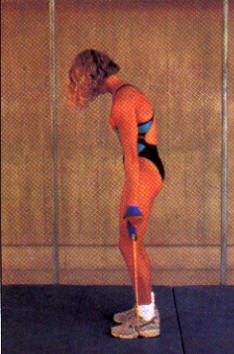
2. Standing Stretch

(For upper muscles.) Place one sling on each wrist. Stand on the rope. Adjust the rope length so your lower back is straight during these stretches. To stretch, press your toes and straighten the upper chest. This will stretch the muscles at the top of the shoulder blade and the base of the neck. If you hunch the upper chest forward and press up, you will stretch the muscles farther over onto the back (rhomboids). Do both positions, for one-and-a-half to three minutes.

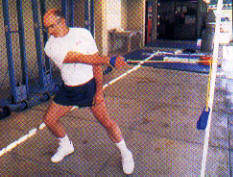
3. Chin Stretch

(For posterior muscles.) This stretch will move your shoulder around under your chin. Attach the rope just below shoulder height. Place a sling on one wrist. Lean away from the point of attachment of the rope. It may take up to 45 seconds before you begin to feel the shoulder blade muscles on your hack stretch, so be patient. Keep shoulder joint muscles tight enough to prevent shoulder dislocation. Stretch left and right side for one-and-a-half to two minutes each.

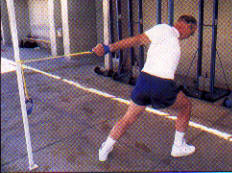
4. Forward Stretch

This stretches the muscles that move the shoulder blade forward (pecs and serratus anterior). Lean forward and rotate the arm to the position that feels most stable. Press forward. Arch the chest forward to increase stress on the pectoral muscles. Stretch left and right side for one-and-a-half to three minutes each.

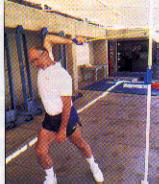
5. Chicken Wing Stretch

This increases rotation of the shoulder blade to allow the arms to come closer together behind the head. Stretch each side for one-and-a-half to two minutes so stress goes to the muscles of the shoulder blade and not to the shoulder joint.

6. Streamlining Stretch

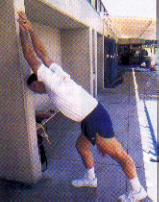
Place your hands high above your head and lean against the wall. See if you can comfortably move your arms well past the ideal streamlined position. Stretch for one-and-a-half to two minutes.

Now, test time! Again, place your arms in the streamlined position above your head and compare this with what you looked and felt like before you began stretching. You should notice some difference after one session.

Marty Hull is a top Masters swimmer and a consultant to the Stanford University Swim Team.


Diving Lessons Learn to Swim Swimming Lessons Teach Baby to Swim


Swimming With Dolphins

Depressed? Swim with dolphins

swimming holiday with dolphins

Taking a dip with dolphins can be a tremendous therapy for people with depression according to a study published on Saturday in the weekly British Medical Journal (BMJ).

Nature lovers – biophiles to give them their scientific name – have long argued that interaction with animals can soothe a troubled mind but this claim has always been anecdotal lacking the scientific data to back it up.

Seeking to find out more psychiatrists Christian Antonioli and Michael Reveley at Britain’s University of Leicester recruited 30 people in the United States and Honduras who had been diagnosed with mild or moderate depression.

The severity of their symptoms was calculated according to established yardsticks for mental health the Hamilton and Beck scales which are based on interviews and questionnaires with the patient.

No antidepressants

The volunteers were required to stop taking any antidepressant drugs and psychotherapy for four weeks.

Half of the group was then randomly selected to play snorkel and take care of dolphins each day at an institute for marine sciences in Honduras.

The other half was assigned to a program of outdoor activities also at the institute that included swimming and snorkelling at a coral reef but without the dolphins.

Two weeks later both groups had improved but especially so among patients who had been swimming with the dolphins.

Measurable symptoms of depression in the dolphin group had fallen by half and by two-thirds according to the two scales – twice as much as in the non-dolphin group.

In addition a self-rating measurement of anxiety symptoms the Zung scale found a fall of more than 20% among the dolphin group compared with a decline of 11% among the non-dolphin groups.

“To the best of our knowledge this is the first randomised single blind controlled trial of animal-facilitated therapy with dolphins ” say Antonioli and Reveley.

“The effects exerted by the animals were significantly greater than those of just the natural setting. The echolocation system the aesthetic value and the emotions raised by the interaction with dolphins may explain the mammals’ healing properties.”

Swim with the Dolphins

Wild and Free Dolphins

Swimming with dolphins – what you need to know

Baby Swimming

Read about us in Woman Magazine

Our Baby Swimming site is an offshoot of our nervous swimmers program offering the opportunity for mothers and babies to :

  • Learn about baby swimming
  • Read articles and find information about teaching baby to swim
  • Purchase Little Dippers Baby Swimming DVD
  • Book one-to-one Baby Swimming Classes in a small private pool
  • Arrange Mother and Baby Swimming Sessions
  • rImprove Mums confidence in the wate
  • Get in touch with other Mums in your area

Babies enjoy much in the water. Swimming is the most complete sport and the first thing to start practicing, even before babies learn to walk or crawl. Until recently, doctors and experts recommended not to take the kids swimming lessons until they met four years, but in recent years has appeared a type of baby swimming highly recommended:
Stimulation exercises in the water with the baby.

Baby Swimming Classes

Baby classes are not lessons for babies to learn to swim, among other things, because it is not until about age four when the musculoskeletal system is developed enough to swim. These baby classes are an activity that seeks aquatic baby stimulation through a series of games that allow you to learn to float and move through the water with the help of their parents.

In this method the role of the father or mother in the water is essential. Through technical guidance of the teacher in charge of the activity, parents participate in the aquatic adventure of your baby. Besides this initial contact will reinforce the bond between parents and babies, living an original, unique experience.

At what age should we begin these baby classes?

The age at which infants begin to learn is not clearly defined. What the experts recommend is that you wait until the baby is four months since it is at that age when you finish the immune system mature small, and the risk of ear infections or colds is lower. The Committee on Sports Medicine and Training of the American Academy of Pediatrics for many years opposed to children under four years give swimming lessons, on the grounds that they considered that the risks  – as cooling child, possibility of water poisoning and infections – and the false sense of security that could produce some parents that their children would be able to swim and self-care in the water were downright harmful to the child’s health. But since 2000 this position has changed dramatically: the Committee stated that the risks can be avoided through precautions and safety measures.

Finally, if you’ve had a good or bad experience trying to find baby swimming, please drop us a line.

Thanks for visiting Baby Swimming and we wish you and your baby every joy and success as your baby  learns to play swim.

Baby Swimming Classes

When it comes to baby swimming classes, we are a little nervous of using that term.  It conjures up visions of the local pool crammed with at least 6 or 8 babies and a swimming teacher on the side barking instruction and expecting every baby to be the same, leaving mothers whose babies don’t seem to conform feeling lost and vulnerable.

There is also the issue of how Mum feels too.  New mothers especially can feel very vulnerable in this situation.  Perhaps they book the obligatory baby swimming classes because they want baby to learn to swim when they have never been a strong swimmer themselves.


Baby Swimming Classes

If you are a strong swimmer and comfortable in the water and are lucky enough to have a resilient baby who will cope with anything thrown at him or her, then go ahead and book those baby swimming classes at your local pool.

If not, you might want to consider booking private swimming classes for you and your baby.  You and your baby will have the total and exclusive use of our small ‘baby-friendly’ pool for your class and the undivided attention of an instructor who will tailor the sessions to both you and your babies needs.

The pool at Swim-Easy is largely used by swimmers with phobias and other nervous non-swimmers as well as individual mother and baby water awareness sessions.  If you see anyone at all before or after your session, it will be a nervous swimmer or another mum with her baby occasionally Dad.  Occasionally they will be leaving as you arrive for your class, or arriving for their class as you leave after yours.  That’s it!   What you won’t see is loads of people lining up for their swimming classes and a frenetic noisy environment that often terrifies babies before they even get in the pool.

We are based in Swadlincote, Derbyshire and can offer baby swimming classes on a week to week basis for those within traveling distance and residential packages for those a bit further afield.

Whilst we offer baby swimming classes phrased as such, each and every session is tailored to you and your baby.  You may book a mother and baby swim that turns into something more adventurous when you and your baby are ready, or you may book a baby swimming class and find that you’d rather have a relaxing play session with your baby.

Baby Swimming DVD

Teach Your Baby to Swim with this inspiring  BBC produced baby swim dvd

little dippers

Teach your baby to swim and love the water

An amazing DVD from award winner Lauren Heston, UK’s most respected instructor of water safety  for babies.

All you need to know about:

  • Water Awareness

  • Self Rescue Skills

  • Fitness

  • Bonding

  • Fun

Are you wary about introducing your baby to swimming? Are you looking forward to getting your baby in the water but think it’s a long way off? Many new Mothers and Dads too, think they can’t take their baby swimming until they are at least six months old or even older. Actually there is no sound basis for this.   All babies have a natural affinity to water and will play and exercise quite safely in water from birth without anxiety. Water-babies is a unique DVD that explains you all you need to know about when and how to get your baby swimming or playing happily in the water.

Water-babies is the brain-child of Lauren Heston, who has been running the highly-successful Little Dippers baby swimming program across the UK for almost 20 years. The DVD was produced by the makers of BAFTA-Award winning BBC series The Human Body.

The DVD/video shows carefully-designed exercises focused on  developing skills for safety, increasing fitness and most important, enjoying the water with your baby. Throughout the DVD, emphasis is placed on safety in the water, revisiting past exercises and steady progress – from simple and fun things to do in the bath to begin with, the program takes you and your baby through progressive development until you feel confident and safe in water with your baby.

Following the DVD will strengthen your baby’s hearts, lungs and respiratory systems  improve your baby’s mental outlook. Your baby will soon be swimming.

This baby swimming DVD will give you countless opportunities for fun and bonding, an ideal beginning as your baby turns into a confident swimmer as he or she grows.

Order the DVD

Click Babies and Swimming Pools for guidelines on information on immunisation, swim nappies, skin care etc.

See also Should You Teach Your Baby to Swim?  and Mother & Child Drown

Teach Your Baby to Swim

Little Dippers   DVD is no longr available

Mother and Baby Swim

Mother and Baby Swimming Classes Mother and Baby Water Awareness in our Private Small Pool

       Our private pool is 18 feet by 10 feet.  You and your baby will have sole use during your session.

First please forgive the use of the words Mother and Baby Swimming.  Sadly we live in a world now dominated by search engines and if that is what people search for and we want you to find this page, then Mother and Baby Swimming, although not what we would choose to call it, is a phrase we must use.  So lets start again.

Water awareness for Mother and Baby.

Everyone agrees that getting your baby used to water / getting your baby swimming at the first opportunity is one of the best starts you can give your baby. Opinions are divided on exactly when to start, but babies are welcome at our swimming pool from as early as a few weeks old providing Mum comes too. Swimming with your baby builds confidence, trust and communication skills. Sessions are kept short so that your baby can experience the glorious sensation of letting the water support him or her and leave the water looking forward to more.

Many mothers feel structured baby swimming classes are a little more than they want whilst struggling to balance a very busy life with a new baby.  A chance to chill out and just relax with in the water is just what is needed so mother and baby both have the opportunity to enjoy the water without any pressure.

For those who can reach us easily, we offer courses ranging from 6 sessions, one a week, and discounts for those wanting to commit to longer.  When Mother and Baby live further afield, we offer a residential to suit.

We are based in Swadlincote, Derbyshire.  Why not come and have a chat or phone.

Teach Your Baby to Swim

Taking the First Steps

Teach Your Baby to SwimWater makes us very afraid when we know how easily a baby could drown. Today we are going to tell you how to teach your baby to swim from when he is very small. They will start to have confidence in the water and you will feel much more secure and calm.

The first contact with the water should be in the bath since you can support the baby much better. Put the baby in the bath and fill it with water until it covers the chest. Do this several times. Also, if you use toys in your bathroom it would be advisable to take them to your lessons in the pool too, so that your baby feels secure with familiar things.  After, swimming lessons will come in the pool.

It is very important that your baby feels relaxed in the water and learns to float, but that does not mean that he is out of danger of drowning. You must always be with your child and either hold him or keep him at arm’s length at all times. Never leave it alone near a swimming pool or even a smaller body of water, like a bucket with three fingers of water, not even forfor such small babies.

Forget the floats. If you bought them to make them feel safer in the water, the experts do not recommend them. Not only can it give them a false sense of security, but they will also adopt an incorrect way of staying afloat, as it makes them take a vertical position in the water when they need to be able to stand horizontally. If you are already used to swimming with them, it will be difficult to take them off.  If you want your child to learn to swim more easily, try these water games:

  • Give your baby a straw and encourage him to blow into the water.
  • Drag him holding his arms while he kicks with his feet.
  • Put him to float on his back, supporting his head and back. Move in zig-zag.
  • Teach him to jump from the edge, holding him first from below with his hands. Then encourage him to jump without help, but stand up, not head down.

After 15 months, although it also depends as soon as the child begins to become familiar with the water, their learning is a little faster, because they already know how to walk and this makes them move better.  Babies who have contact with water will begin to crawl , walk, move, communicate with other children much quicker.

Finally, it is important, to teach certain basic rules about swimming from a very early age, which will provide some extra safety measures to enjoy the lessons safely:

  • Do not get into the water without first tellng an adult
  • Do not jump in without permission or supervision of an adult
  • Shower before and after the pool
  • Use other protection methods such as sunscreen, flip flops to avoid fungus in swimming pools or goggles to protect the eyes from chlorine or salt
  • Do not run or play on the curb of the pool

Swimming Lessons for Kids

Lessons for Kids

Swimming lessons are a great way for kids to stay active and learning to swim is an essential tool for kids to at an early age to keep them safe and at ease around water. Learning to swim if a skill that will stay with a child forever and our swimming pools are used by olympic swimmers and kids alike, giving the kids the chance to see where their new hobby could lead.

Swimming Lessons for Kids

Why are swimming lessons great for kids? It’s one of the very few areas where kids are completely independent, especially before they are school age. The water supports their weight and they are free to move their legs and arms as much as they want. Kids love it! Swimming classes are also a great bonding experience for kids, moms and dads too.

We know other Mums (and Dads) would find it useful to see testimonials here for Baby Swimming Classes in Aberdeenshire so if you can help with this, we would love to here about your baby swimming experience with local swimming classes.  Research has shown, kids take swimming classes, are far better developed socially, mentally and physically. Did you know that kids sleeping and eating patterns are improved by regular exercise?