Teaching your child to swim

Written by Irene Bouette from Learn to Swim-With-Us

Every parent wants their child to swim for various reasons, the main one being that they want their child to be able to get out of trouble if they find themselves in the water. This is why swimming lessons are important to the parent.

Teaching children to swim is a challenging task unless the child is a ‘natural in the water’. Unfortunately for the parents there are not many of those about.

When giving swimming lessons, to help the child to understand the techniques, it needs a softly, softly approach,  together with play, to give the child the understanding that the water will carry them. Because it is not always possible to explain a technique to them, the art of play is important so they get the message and realise what you are trying to get them to achieve.

This can be done in various ways during the lessons, playing with them in the water or using objects that they find fun so the water will not seem too daunting.

Usually the attention span is small. Half an hour is the maximum and the whole time should be in an upbeat manner, never shouting or making the child feel that he/she is a failure.

I find that one to one in the water is valuable because the child will not feel embarrassed if he feels scared.Private Swimming Lessons

My private pool is available for your child and they will be the only child in the pool.  This way your child knows that his/her swimming lesson is important  to them, to you and their instructor whilst at the same time the pool is small enough not to be intimidating.

My prices start from £15.  Please email for more information.

Tenerife Fish

Tenerife waters are deep and the influence of the gulf currents is strong, making them the ideal habitat for many species of fish. Big eye, Yellow fin and Albacore Tuna can be found from September to April, and skipjack tuna nearly all year round! The big game fishing season normally starts in February for tuna fishing, being April and February the better months; marlin fishing between May and September, peak season is June, July & August.

  • parrot fish
  • sardines
  • samas
  • wreckfish
  • pollocks
  • grouper fish
  • combers
  • horse-mackerel,
  • cuttle fish
  • mackerel

Tenerife Fish La Vieja

La vieja is a typical Canary Island fish that is very little known in the peninsula. It is a fine white fish, with some similarity to the sole and very traditional in the islands’ cuisine.

Sea bass, lubina in Spanish, is a silver fish with a white belly that is very popular in Spanish restaurants . It has white, firm flesh and a delicate flavor. It is served whole baked in the oven, or grilled, served with salt and lemon.

300 Species of Tenerife Fish

Cavalier & Blue Marlin Charters have an excellent guide to Canary Islands fish. Although not in Tenerife the local fish are much the same. Sports fishing is very popular and the search for Marlin in Tenerife waters is usually very successful.

See the fish

Cavalier & Blue Marlin Charters
Puerto Rico
Gran Canaria
+34 607 913 313

Fishing Boats Tenerife

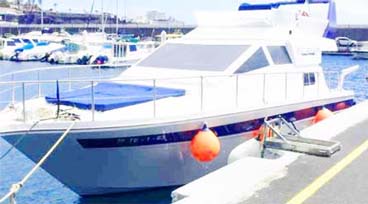
Renting a boat for your entire holiday will not be cheap. Below are some useful sample prices. A sensible option is is to keep your boat accommodation and your fishing separate. Moovers 2 can sleep 4 to 6. Priced at 150€ pp weekly for guests not fishing, it means a great price for every member of the group. For fishing we recommend Tenerife Sport Fishing. About their Boats

We offer you a sensible alternative of rent your boat accommodation from as little as 300€ pp weekly while we organise your itinerary at affordable prices.

Fishing Boats at Night

Los Abrigos Fishing Village

  • To see the real fishing boats of Tenerife then a visit to Los Abrigos is a must.
  • Rise early if you want to see them go out.
  • You can walk there from the boat, it’s a lovely walk early morning.
  • Evening is well worth a trip with many fish restaurants for which Los Abrigos is famous.

Tenerife Sport Fishing Boats

Prices start at 59€ – Click the image for more details

No Limits One
28 foot Bertram with 2 Volvo Penta 210hp engines, which has been constantly kept up to date with the latest technology, Renewed in 2022. Sonar, Fish Finder, toilet, cabin, ice box, sofa, sun-bed on the fly bridge.

No Limits Two
41 foot Rodman, with 2 Volvo Penta 450hp engines, sonar, radar, fish finder, walk around deck, sun bed, toilet, shower, seating on the fly bridge, sofa, kitchen, cabins.


Tenerife Prices for Boat Trips and Boat Charter

Luxury yes, but not affordable for most of us.

Sample Boat Charter Prices


Sample Boat Trip Prices


Fishing Holidays

The No Limits Crew provide first class fishing charters.

Our passion for fishing goes all the way through South and West Tenerife, counting with more than 20 years fishing! There are endless possibilities for everyone, new and experienced anglers who want to discover the wonders of these coasts.

We want to guarantee you the best Private Charter Fishing Experience in Tenerife! Our newest addition to the No Limits fleet is this beautiful 41 foot Rodman, with 2 Volvo Penta 450hp engines, sonar, radar, fish finder, walk around deck, sun bed, toilet, shower, seating on the fly bridge, sofa, kitchen, cabins, and so much more!

Location: Pier 11 Puerto Colon, Adeje

Phone: 659 62 35 35

Find No Limits Sport Fishing on Facebook

Maver Poles

Prices 2023 – check at Maver Poles

Latest Maver Pole Range

  • MV-RXX 16m £3,999
  • MV-RXS 16m £2,699
  • MV-R4 16m £3,000
  • MV-R3 16m £2,599
  • MV-R2 16m £1,899
  • MV-R1 16m £1,499
  • MV-R X Power 13m £600
  • Signature Pro Power 1000 Pole £288
  • Definition XR 13m/14.5m £1,00 – £1,200
  • Definition XS 13m & 14.5m £750 – £850
  • MV-R competition 16m pole package £1,700
  • Oculus 7m margin pole £300
  • Reality 6m pole £83
  • Reality 9.5m margin pole £110
  • Signature 8m whip 350

Pole Fishing

Fishing with a Pole

New Shimano Aero Poles

Jump to Pole Fishing Video

There is some evidence that the fishing pole was used long before 2000 BC. in different areas of the world. The need arose when it came to fishing in deeper waters. It’s great technological evolution took place when the rod began to be used with a resistant line and hook. First, the line was tied to the rod, then rings were used to guide the lines. The longer the line, the easier it was to tire the fish. After this the reel was invented, to avoid entangling the line.

What is Pole Fishing?

Basically, pole fishing is a method of float fishing where the float is fished just below the tip of the pole. The float “rig” is connected directly to the pole tip; unlike waggler fishing there is no free running main line or a reel. The distance you can fish is therefore limited by the maximum length of your pole. Poles are available at lengths of up to 16m and (at least with current technology) this seems to be the limit of what an angler can comfortably handle due to the leverage of the protruding pole from the anglers’ grip (although there have been experiments from a few manufacturers with poles as long as 20m).

Best Pole for Beginners

There are specialist fishing poles designed for nearly every type of fishing. As a beginner, we can pretty well avoid all of these. Often, a lot of this ‘specialization’ for a specific type of fishing is just clever marketing, the same as the term ‘beginners pole’.


Pole Fishing Video

Are you looking to get into Pole Fishing? Adam gives you everything you need to know about getting started with pole fishing. From start to finish, Adam shows you how to set up your new pole, how to elasticate your pole, how to tie your first pole rig, a few simple baits and ultimately, how to catch more fish on the pole!

Wild Carp or King Carp

Jump to Video Wild Carp v King Carp

What’s the differences between wild carp and king carp? How can you catch the true wild fish?

Genetically there is in fact very little difference between wild carp and king carp. Stemming from the River Danube carp were transported around the world originally by the Romans. Over the years they have been selectively bred to grow faster and bigger firstly because they were an important food source and more recently for us to fish for.

Telling the difference between true wild carp and skinny commons is very difficult particularly as there is nothing to stop them breeding together. Wild carp generally have longer barbules a long dorsal fin and a large head. The body is almost chub-like in shape if the fish grow to bigger than about ten pounds then the chances are they are not true wild carp.

You definitely should try cooking with carp.  There are many great fish recipes online but do try not to smother your carp in sauce the first time you cook with it.  You can only make recipe decisions once you know the true taste of your fish.

Carp really became widespread in the British Isles as a food fish brought to this country from mainland Europe in the Middle Ages. So to find true wild carp now you should look for ancient ponds that have not been stocked with king carp. Estate lakes are your best bet for true wild carp although as more venues become stocked with king carp finding true wild carp will not be an easy task.

The wild carp has a larger tail for its size and has an altogether leaner and longer body.


Video Wild Carp v King Carp

Top 5 Places to Fish in Alaska

  • Chilkat River
  • Susitna River
  • Kenai River
  • Kah Sheets Lake
  • Kasilof River

Alaska is known worldwide for truly amazing fly fishing. It is no wonder that every year fishermen come from all over the world to catch a piece of the action. But once you decide to take a fishing trip to Alaska, where do you go to find the best fly fishing opportunities? There are countless options to choose from, depending on what part of the state you will be visiting.

Chilkat River

Located in the south-east part of the state, the Chilkat River is an ideal place for fly fishing for salmon. There are five types of salmon common in Alaska ‘s Chilkat River including silver, red and king salmon. Dolly Varden, steelhead and trout are also available. This area also serves as an important habitat for the bald eagle, so you could find eagles fishing alongide you. The Chilkat River is near Skagway and Haines, so you can use either of those cities as a base to fish from.

Susitna River

Running through the mountains of south-central Alaska, the Susitna River is another great place to go fly fishing. Some of the fish species present in the Sustina include rainbow trout, all types of Pacific salmon (as well as the king, red and silver), Arctic grayling and Dolly Varden. The suburbs of Sustina are near, so you can stay in the city and then take seaplane excursions from there to the river.

Kenai River

By far the most famous river in Alaska, the Kenai Peninsula is known for spectacular fly fishing especially salmon in particular king. The Kenai River is located in the south-central part of Alaska and extends from Kenai Lake to Cook Inlet. King salmon, steelhead, coho and sockeye salmon can be found in the area. The king salmon fishing is the most popular fishing on the river, and for good reason. Most of the greatest kings were recorded caught in the Kenai River. The river is easily accessible by car and there are several cities that can be used as a base.

Kah Sheets Lake

A beautiful spot, quieter than most, the lake abounds with sockeye salmon,bass, bluegill and crappie.  Although other options are available booking a cabin close to the lake has to be one of the most appealing options. Otherwise look for accommodation  in Wrangell, Petersburg.

 Kasilof River

Located in the south-central part of the state, the Kasilof River is another place for fly fishing. In the Kasilof you can find many species of fish, same as those available in the Kenai River, but Kasilof has a much more relaxed atmosphere and will be less crowded. Fish species that are most popular here are the red salmon, trout, chinook and coho salmon. The Kasilof is reachable by car, so you can use any number of cities in Alaska as a base.

There are so many great places for fly fishing in Alaska, with these top 5 we have only touched the tip of the iceberg. The Alaska frontier is vast and full of fish ready for you to enjoy. No matter where you go fly fishing in Alaska, it’s sure to be an amazing experience. Great fishing!

Sea Fishing

Jump to Sea Fishing Video

What is it called when you go fishing in the ocean?
Saltwater Fishing – fishing in salt waters (oceans). Also called “tidal waters fishing”.

Targeting a species and learning all the methods and situations that can increase your catch rate can be a very important factor in increasing you catch rate when sea fishing. There are a vast number of different species, such as Pollock, fish that can be found in many different locations and can be fished for using many different methods. Where to fish for many species include;

  • Rock and reef marks are very popular locations for fish.
  • Both inshore and off shore wrecks will produce various fish pollock to a good size.
  • Piers  will produce fish all year around but. generally these fish are not of a great size.
  • Weed beds and deep kelp  hide a lot of predators and prey.
  • Broken ground can hold all sorts of species including the pollock. Some fishing techniques
  • Lure fishing. Deep sea wreck fishing often requires heavy weights to take a jelly worm or metal lure to the sea bed.
  • Saltwater fly is effective when fish are in shallow water and fish can be of all sizes and at a whole range of locations including piers, reefs and weed beds.  Flies that mimic small fish and prawns work well, sea trout flies and saltwater flies are popular.
  • Float fishing can be used almost anywhere in shallower water.Common baits are sand eel and fillets of fish bait.
  • Ledgering can work well using the normal  baits fish.
  • Live baits work well for many fish usually resulting in a strong take and suitable equipment needs to be used.

Common  Catches when Sea Fishing

The sky’s the limit, or in the case of sea fishing, the sea’s the limit. Even fishing inshore waters, anglers can catch everything from tarpon to flounder. Anglers fishing the northeast coast can expect flounder and cod to congregate in bays and river mouths. Striped bass and bluefish fall for lures from surf-casters, as will weakfish and sea trout.

Farther south, red drum (redfish), tarpon, and bonefish excite anglers as they cruise the shallow flats of bays. These fish can be taken on traditional gear or fly-fishing tackle, nothing special needed for sea fishing. Snook fight like the saltwater version of the large-mouth bass, and sharks cruise off many coasts. With sea fishing, you don’t really know what you’re going to catch next, which is part of its great allure.

Sea Fishing Video