Teaching Swimming

I didn’t write the article below, and whilst I agree with most of what’s been said, I also hold some very strong views on the subject. So first, please think about what I have to say.

My fear of water lasted till I was almost 50 when I finally learned to swim with the Total Immersion method. I was so bad I would even panic in the shower if the water went in my face. Having finally got past the notion that I could somehow learn to swim without getting my face wet, I got  the message. I went on to qualify as an instructor, then a life guard, then learned to dive. For a while I taught water phobics and people who had simple never mastered swimming,  with not a single failure.

Before long, the highly qualified tutors that taught me were asking my advice with questions about their own teaching, for example ‘How can I possibly teach them when they won’t put their face in the water?’ The answer is you can’t until you deal with the problem. It’s just like any other fear, not rational. and logic, shouting, coaxing just won’t work!

So here are the points I want to make:

  • If someone, child or adult, is frightened of putting their face in the water, don’t move on.
  • Don’t use floats or water-wings – it won’t help long term.
  • People that can swim a little breaststroke MUST be re-taught if they are afraid of going under, otherwise they can put themselves in very dangerous situations in the pool or the sea.
  • Start with dipping down into the water, as little as chin level if that’s what it takes, and  gradually work towards going under, holding the nose. Advance to blowing out when coming back up. If it takes 10 lessons to get that far – so be it.
  • The next step is how to get back in control once the feet leave the bottom of the pool. It’s pointless to keep telling them everyone comes back up, they have to experience it and feel balanced and relaxed.
  • Simple exercises  where they float in a tucked up ball, then stretch out flat, then bring their arms down (for impetus) and they push their legs toward the bottom BEFORE they lift their head. Don’t let them raise their head first as this will unbalance them and they will feel out of control. Build up to 3,4,5 tucks/stretch/back to tuck before coming up.
  • After this stage they will be able to 1) put their face in 2) have confidence they can always float and get back up 3) the tendency for panic will be greatly diminished 4) they will trust that you understand, unlike most other instructors they have given up with.
  • Now you are ready to move on with more traditional methods, but concentrate heavily on balance techniques and DO NOT under any circumstances resort to floats. Kicking off the side, to touch the bottom, then glide back up, seeing how far they can get each time, is hugely beneficial for confidence and a feeling of achievement!

Happy Teaching!


Teaching Swimming

Teaching swimming sounds like an easy task for those who know how to swim. However, if you are not careful, you can scare people (especially children) away from water for a good amount of years.

How you teach swimming is very important. If swimming is not taught correctly pupils can develop a phobia. Teachers have to understand the importance of not rushing their students as they do not want fears to develop.

When familiarising students with water teachers should have a cheerful attitude and hold lots of understanding. Each student has different fears and needs, and teachers should learn these early on in the lessons. Teachers should offer plenty of reassurance and encouragement and sense when their students are apprehensive about a particular activity. If students show fear when learning something new, teachers have to be able to recognise this and take a step back, later teaching the activity with a different approach.

Teachers have to try to develop self-confidence with their students. This can be achieved by offering plenty of praise. Students learn at a quicker pace if they enjoy what they are being taught. Therefore it is necessary not to make swimming a chore for the pupil. Teachers will need plenty of patience as swimming should be taught at a self-paced level.

On the pupils first day of swimming teachers should not have high expectations of what the pupil will learn. Just allowing the student to get his or her feet wet is sufficient, especially if they enjoy themselves. When the student is brought into the water for the first time it is a good idea that the teacher walks around the entire pool holding the students hand. This will allow the student to see how deep the water is, and some of their fears may fade. This will not happen if the student does not trust the teacher. Without trust, there is fear and so little enjoyment; without enjoyment, there will be little practice and without practice, beginners will not develop skills or a positive attitude required to learn how to swim.

To attract children to water toys and games can play a very important part. Whether it be a small boat that the student can float on the water, or a pair of goggles that will make the student feel more at home with the more experienced swimmers, toys and games will help the student to enjoy the pool.

To teach children how to place their face in the water, it is encouraged to allow the student to blow bubbles and the occasional splash of water on their face. Some students will not place their face in the water without a pair of goggles. If goggles give the student confidence, then goggles should be worn.

If the student will not let go of the edge of the pool, then the use of floatation aids can be useful. Games and lots of fun activities will also help to encourage the child to take a step away from the edge. If the student refuses to let go of the edge of the pool, then let them stay there for a few lessons until they become more familiar with the water.

When teaching someone to swim it is important to remember that they should learn at their own pace. They will not develop confidence if they do not trust their teacher, and they will not enjoy the water if they are forced to enter it before they are ready. Some students learn at a quicker pace than others, but in the end they all usually learn to swim as well as each other.

Written by Ginny Carter


Teaching your child to swim

Written by Irene Bouette from Learn to Swim-With-Us

Every parent wants their child to swim for various reasons, the main one being that they want their child to be able to get out of trouble if they find themselves in the water. This is why swimming lessons are important to the parent.

Teaching children to swim is a challenging task unless the child is a ‘natural in the water’. Unfortunately for the parents there are not many of those about.

When giving swimming lessons, to help the child to understand the techniques, it needs a softly, softly approach,  together with play, to give the child the understanding that the water will carry them. Because it is not always possible to explain a technique to them, the art of play is important so they get the message and realise what you are trying to get them to achieve.

This can be done in various ways during the lessons, playing with them in the water or using objects that they find fun so the water will not seem too daunting.

Usually the attention span is small. Half an hour is the maximum and the whole time should be in an upbeat manner, never shouting or making the child feel that he/she is a failure.

I find that one to one in the water is valuable because the child will not feel embarrassed if he feels scared.Private Swimming Lessons

My private pool is available for your child and they will be the only child in the pool.  This way your child knows that his/her swimming lesson is important  to them, to you and their instructor whilst at the same time the pool is small enough not to be intimidating.

My prices start from £15.  Please email for more information.

Building a Swimming Pool?

Ray Cronise has some answers!

A Few Things to Consider

A reader asks: We are just stumped! We’ve been looking into purchasing a pool for our small backyard. We’ve looked into fibreglass pools at this point and like the way they look. We seem to hear a different story from each person we ask regarding the purchase of a new pool. Most agree it’s the installer who is the key. Is that your consensus as well? How do we check on the installer, other than relying on the references given to us by the pool company?

From Ray: First I want to disclose that I also am a manufacturer of fibreglass pools, so I will try to be as objective as possible.

A fibreglass pool is a great choice for your back yard and will absolutely be the lowest maintenance pool. You can look on our site for lots of other background information on these pools. Since I come from a Composites Engineering background, we are a little different than the other companies you might find.

You are correct, that the installer is everything! Unfortunately, fibreglass pools tend to lower the barrier of entry into the installation pool business side and so they tend to attract what I might affectionately refer to as Billy-bob and the back hoe gang. You get the point. On any builder first check the BBB in your area. Also request a list of references AND a list of jobs currently under construction. This will give you the opportunity to see who you are dealing with directly.

A few more general things to consider:

  • Don’t allow them to talk you into exposed coping: go with pavers, stone, or a cantilever deck
  • Consider Tile, but don’t allow it to be installed at the factory – this will result in unlevelled tile at the waterline
  • Request that the pool be installed with no main drain. They are not necessary for circulation and can pose and entrapment hazard.
  • Try to find builders that are members of NSPI. Also ask if they are Certified Building Professionals (CBPs)

Finally, be careful of dark colours and pools. We have colored surfaces, but do not have extremely dark colours. These fail after some time and fibreglass, unlike liners or shotcrete, are not designed to be resurfaced in the field.

Happy Swimming!!!

Ray Cronise, The RTR Group, Inc.

Diving Holidays

Learn to dive on holiday in Tenerife.

A Diving Club where you can experience Scuba Diving safely for the first time through an approved PADI Discover Scuba Diving Program; improve your existing knowledge and gain experience through PADI certified courses; or for those already qualified, join like-minded fellow divers and club members for a truly memorable diving experience; all whilst having fun in the water with your qualified guides and instructors!

Budget accommodation available.

 Granadilla Diving Tenerife.


Visit Tenerife Boat Holidays

Go at your own pace, beginners try dive or Padi qualifications. Multi function holidays to allow for groups with different interests.

Swimming Holidays

Diving Holidays in Tenerife

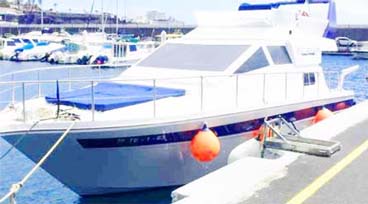
Moored at Amarilla Golf Marina it boasts 1 double, 2 singles and sleeps 4 to 6 people. With plenty of bars and restaurants for the evening, it also has easy access for golfers.


Our recommendation for divers is Granadilla Diving.

Granadilla Diving

Granadilla diving also offer accommodation but for those wanting to relax away from the learning, or those with family to entertain, we recommend our yacht  MOOVERS II.


Tenerife Fish

Tenerife waters are deep and the influence of the gulf currents is strong, making them the ideal habitat for many species of fish. Big eye, Yellow fin and Albacore Tuna can be found from September to April, and skipjack tuna nearly all year round! The big game fishing season normally starts in February for tuna fishing, being April and February the better months; marlin fishing between May and September, peak season is June, July & August.

  • parrot fish
  • sardines
  • samas
  • wreckfish
  • pollocks
  • grouper fish
  • combers
  • horse-mackerel,
  • cuttle fish
  • mackerel

Tenerife Fish La Vieja

La vieja is a typical Canary Island fish that is very little known in the peninsula. It is a fine white fish, with some similarity to the sole and very traditional in the islands’ cuisine.

Sea bass, lubina in Spanish, is a silver fish with a white belly that is very popular in Spanish restaurants . It has white, firm flesh and a delicate flavor. It is served whole baked in the oven, or grilled, served with salt and lemon.

300 Species of Tenerife Fish

Cavalier & Blue Marlin Charters have an excellent guide to Canary Islands fish. Although not in Tenerife the local fish are much the same. Sports fishing is very popular and the search for Marlin in Tenerife waters is usually very successful.

See the fish

Cavalier & Blue Marlin Charters
Puerto Rico
Gran Canaria
+34 607 913 313

Fishing Boats Tenerife

Renting a boat for your entire holiday will not be cheap. Below are some useful sample prices. A sensible option is is to keep your boat accommodation and your fishing separate. Moovers 2 can sleep 4 to 6. Priced at 150€ pp weekly for guests not fishing, it means a great price for every member of the group. For fishing we recommend Tenerife Sport Fishing. About their Boats

We offer you a sensible alternative of rent your boat accommodation from as little as 300€ pp weekly while we organise your itinerary at affordable prices.

Fishing Boats at Night

Los Abrigos Fishing Village

  • To see the real fishing boats of Tenerife then a visit to Los Abrigos is a must.
  • Rise early if you want to see them go out.
  • You can walk there from the boat, it’s a lovely walk early morning.
  • Evening is well worth a trip with many fish restaurants for which Los Abrigos is famous.

Tenerife Sport Fishing Boats

Prices start at 59€ – Click the image for more details

No Limits One
28 foot Bertram with 2 Volvo Penta 210hp engines, which has been constantly kept up to date with the latest technology, Renewed in 2022. Sonar, Fish Finder, toilet, cabin, ice box, sofa, sun-bed on the fly bridge.

No Limits Two
41 foot Rodman, with 2 Volvo Penta 450hp engines, sonar, radar, fish finder, walk around deck, sun bed, toilet, shower, seating on the fly bridge, sofa, kitchen, cabins.


Tenerife Prices for Boat Trips and Boat Charter

Luxury yes, but not affordable for most of us.

Sample Boat Charter Prices


Sample Boat Trip Prices


Shimano Tackle

***  Shimano Fishing Tackle  ***

shimano tackle

Shimano Fishing Tackle

Shimano Fishing Tackle Range

  • PowerPro Red Braided Mainline
  • PowerPro Red Braided Mainline
  • PowerPro Yellow Braided Mainline
  • Shimano Aerlex XSB Reel
  • Shimano Aerlex XTB 10000 Spod Reel
  • Shimano Aerlex XTB Reel
  • Shimano Aero BB Fishing Reel
  • Shimano Aero Technium MGS XSD Reel
  • Shimano Aero Technium MGS XTD Reel
  • Shimano Aero X5 Distance Feeder Fishing Rod
  • Shimano Aero X5 Distance Heavy Power Feeder Fishing Rod
  • Shimano Aero X5 Distance Power Feeder Fishing Rod
  • Shimano Aero X5 Match Float Fishing Rod
  • Shimano Aero X5 Pellet Waggler Fishing Rod
  • Shimano Aero X5 Precision Feeder Fishing Rod
  • Shimano Aero X5 Precision Multi Feeder Fishing Rod
  • Shimano Aero X7 Distance Feeder Fishing Rod
  • Shimano Aero X7 Finesse Feeder Fishing Rod
  • Shimano Aero X7 Precision Feeder Fishing Rod
  • Shimano Aero XR Fishing Reel
  • Shimano Baitrunner DL Reel
  • Shimano Baitrunner Oceanic Reel
  • Shimano Baitrunner ST FB Reel
  • Shimano Baitrunner ST RB Fishing Reel
  • Shimano Baitrunner X-Aero FB Fishing Reel
  • Shimano Baitrunner X-Aero RA Reel
  • Shimano Baitrunner XT RB Reel
  • Shimano Baitrunner XTB CI4+ LC Reels
  • Shimano Baitrunner XT-B LC Reel
  • Shimano Ball Bearing
  • Shimano Bassterra LRF Fishing Rod
  • Shimano Bassterra Sea Bass Fishing Rod
  • Shimano Beastmaster BX Slim Boat Fishing Rods
  • Shimano Beastmaster XB Reel
  • Shimano Caius Reel
  • Shimano Catana RC Reel
  • Shimano Click Spring (B)
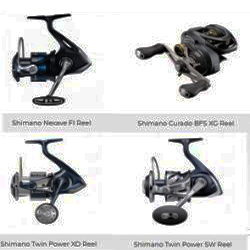
  • Shimano Curado BFS XG Reel
  • Shimano Curado DC Fishing Reel
  • Shimano Exage Monofilament
  • Shimano Exsence Reel
  • Shimano FX Reel
  • Shimano Kairiki 4
  • Shimano Kairiki G5
  • Shimano Lever Shaft Fishing Reel Body
  • Shimano Nasci FC Reel
  • Shimano Nexave FI Reel
  • Shimano Power Aero 14000 XTC Fishing Reel
  • Shimano Power Aero XSB Reel
  • Shimano Power Aero XTB Fishing Reel
  • Shimano Purist BX-1 Barbel Fishing Rods
  • Shimano Sahara DH RD Reel
  • Shimano Sahara FJ Fishing Reel
  • Shimano Sahara RD Reel
  • Shimano Sedona FI Reel
  • Shimano Sienna FG Fishing Reel
  • Shimano Sienna RE Reel
  • Shimano SLX DC Fishing Reel
  • Shimano Speedmaster XSC Reel
  • Shimano Speedmaster XTC Reel
  • Shimano Speedmaster XTD Reel
  • Shimano STC Mini Tele Spinning Fishing Rods
  • Shimano STC Multi-Length Spinning Fishing Rods
  • Shimano STC Spinning Fishing Rods
  • Shimano Stella SW Reel
  • Shimano Stradic CI4+ RA
  • Shimano Stradic GTM RC Reel
  • Shimano Super GT RD Reel
  • Shimano Sustain FJ Reel
  • Shimano Tiagra TI-50WA Fishing Reel Handle Assembly
  • Shimano Tribal Carp Landing Net
  • Shimano Tribal TX-1A Fishing Rods
  • Shimano Tribal TX-2 Carp Fishing Rod
  • Shimano Tribal TX-Ultra A Fishing Rod
  • Shimano Twin Power SW Reel
  • Shimano Twin Power XD Reel
  • Shimano TX-2 Cork Fishing Rods
  • Shimano TX-2 Stalker Rod
  • Shimano TX-A Fishing Spod Rod
  • Shimano TX-Extreme Spod & Marker Fishing Rod
  • Shimano TX-Plus Spod & Marker Fishing Rod
  • Shimano Ultegra 3500 XSD Competition Reel
  • Shimano Ultegra 3500 XSD Competition Reel Spare Spool
  • Shimano Ultegra CI4+ XSC Reel
  • Shimano Ultegra CI4+ XTC Reel
  • Shimano Ultegra CI4+ XTC Reel 14000 Main Shaft
  • Shimano Ultegra FC Fishing Reel
  • Shimano Ultegra Spod Fishing Spare Spool
  • Shimano Ultegra XSD Reel
  • Shimano Ultegra XSE 3500 Competition Fishing Reel
  • Shimano Ultegra XSE Fishing Reel
  • Shimano Ultegra XTD 5500 Fishing Reel
  • Shimano Ultegra XTE 14000 Fishing Reel
  • Shimano Ultegra XTE Spod Reel
  • Shimano Vanford Fishing Reel
  • Shimano Vengeance AX Boat Slim Fishing Rods
  • Shimano Vengeance CX Sea Bass Fishing Rod

Carp Fishing

Fishing for Carp

Carp Fishing

Jump to Carp Fishing Video

One of the largest members of the minnow family and a close relative of the goldfish, the common carp is among the least – favoured targets of freshwater anglers in North America. Common carp exist in good supply and in relatively large sizes (compared to most other species), and provide an underutilized resource for anglers, not to mention an ample source of protein. In some circles carp are highly regarded as a food fish and can be prepared in many ways. ID. The common carp has a deep body form and a heavy appearance.

Distinctive features include a short head, rounded snout, single long dorsal fin, forked tail, and relatively large scales. The mouth is toothless and sucker like, adapted to bottom feeding, and the upper jaw projects slightly past the lower one. The common carp has a single serrated spine at the front of the dorsal and anal fins and two pairs of fleshy barbels on either side of its mouth. Colouring ranges from gold to olive to brown, with a yellowish colouring on the lower sides and belly and a reddish tint to the lower fins. Each scale on the upper sides of the fish has a concentrated dark spot at its base and a conspicuous dark rim.

Common Carp Cyprinus carpio

Juveniles and breeding males are usually a darker green or grey with a dark belly, and females are lighter. Habitat. Common carp are incredibly hardy and flexible in their habitat preferences. Primarily bottom – dwelling fish, carp like quiet, shallow waters with a soft bottom and dense aquatic vegetation. Although they favour large turbid waters, they also thrive in small rivers and lakes. They can live in low – oxygen environments and can tolerate temperature fluctuations and extremes. In some northern waters where the fish are abundant and such terrain is lacking or offers no food, carp will cruise over shallow, rocky flats and shoals, browsing along the rubble bottom. Food. Omnivorous feeders, carp have predominantly vegetarian diets but will feed on aquatic insects, snails, crustaceans, annelids, and molluscs.

Carp Fishing Video

Aquatic plants and filamentous algae are the most popular food groups. They grub sediments from the bottom with their sucker like mouths, uprooting and destroying vegetation and muddying the water. Carp primarily spend their lives in small groups and are inclined to roam for food. Angling. Because carp primarily eat aquatic plants, and not other fish, they are less receptive than many other species to the most commonly practiced methods of fishing in North America. Nevertheless, they are strong fish and hearty battlers, capable of stretching a fishing line and testing the skills of most anglers. Getting a carp to take your offering can be a challenge, as they are not impulsive predators or ambush strikers.

For the most part, they are not chasers or stalk – and – attack hunters. They are unlikely to strike most lures, although they occasionally strike a slow – moving jig, and either a weighted or a dry fly. Spinning, spin-casting, fly-casting, and bait-casting tackle are all used to land carp, but spinning is probably the most functional method. In North America, carp have been caught on an assortment of bait, primarily dough-balls, corn, worms, processed baits, and commercially prepared baits, with and without chumming. Although they primarily feed on the bottom, carp also feed on or near the surface as well as at mid-levels. Fishing for carp is mostly a waiting game, but stealthy anglers can opt to take a more aggressive approach and hunt for them, stalking and casting to visible fish. the equipment list.